
SureAdvice
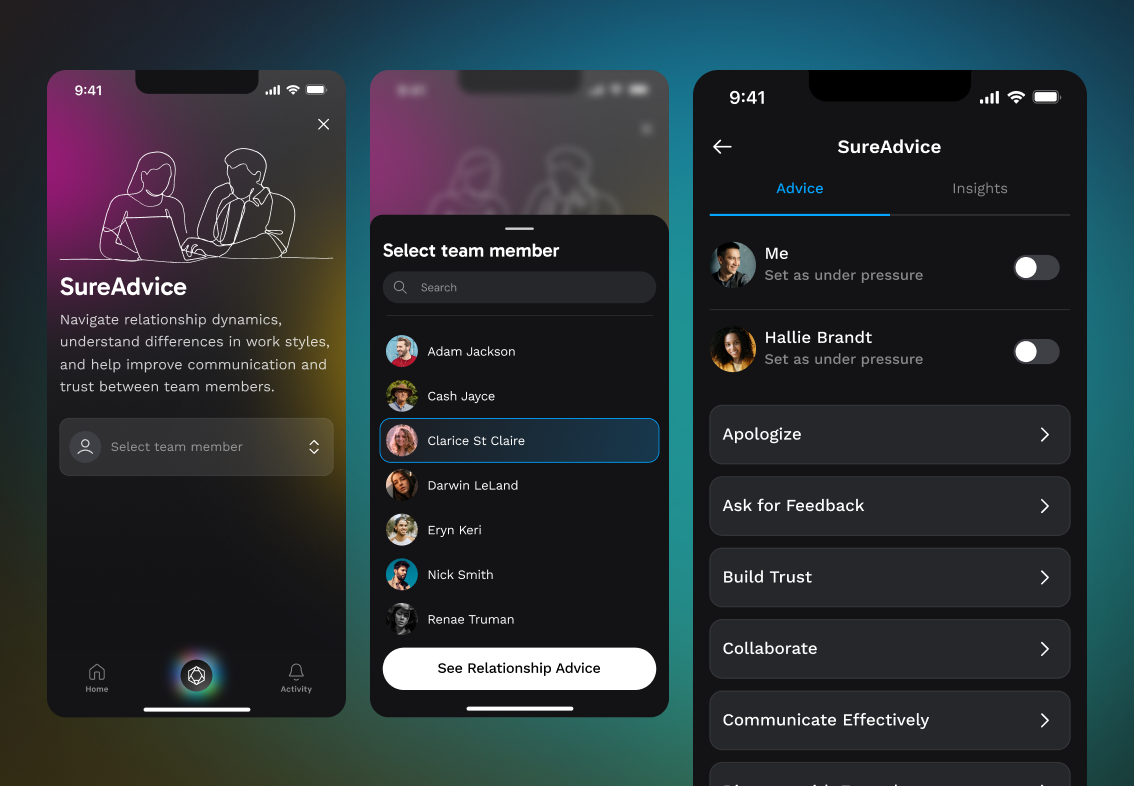
Translating psychometric complexity into advice people can act on.
Prism turns a detailed personality assessment into behavioral signals across processing, decision making, conflict management, motivation, and fundamental needs—including how those patterns may change under pressure. SureAdvice needed to combine that data across two people and answer a much simpler question: “How should I approach this person right now?”
I owned the module’s product design from requirements through production alignment. My role was to create an interaction model that could surface nuanced, relationship-specific guidance without exposing users to the complexity of the system generating it.
Building trust without making users decode the model.
AI advice can feel generic when its reasoning is invisible, but overwhelming when every input is exposed. I designed the content hierarchy to lead with the useful recommendation, then connect it back to relevant Prism signals so users could understand why the advice fit this relationship.
Progressive disclosure kept the primary experience concise while preserving access to deeper personality context. The goal was not to teach psychometrics; it was to make a sophisticated model feel legible, credible, and humane in the moments users needed it.
Optimizing the path from relationship to next action.
I explored the essential sequence at low fidelity: choose a colleague, identify the situation, scan the recommendation, and understand the behavioral dynamic behind it. Because the core use cases and psychometric model were already defined, I kept discovery intentionally lean and moved quickly into the shared component system, where we could judge the real hierarchy and interaction cost on a mobile screen.
From there, I tightened selection patterns, content structure, navigation, and calls to action around fast comprehension. Repeated critique with design leadership and engineering kept the solution ambitious but buildable within the larger six-month product timeline.
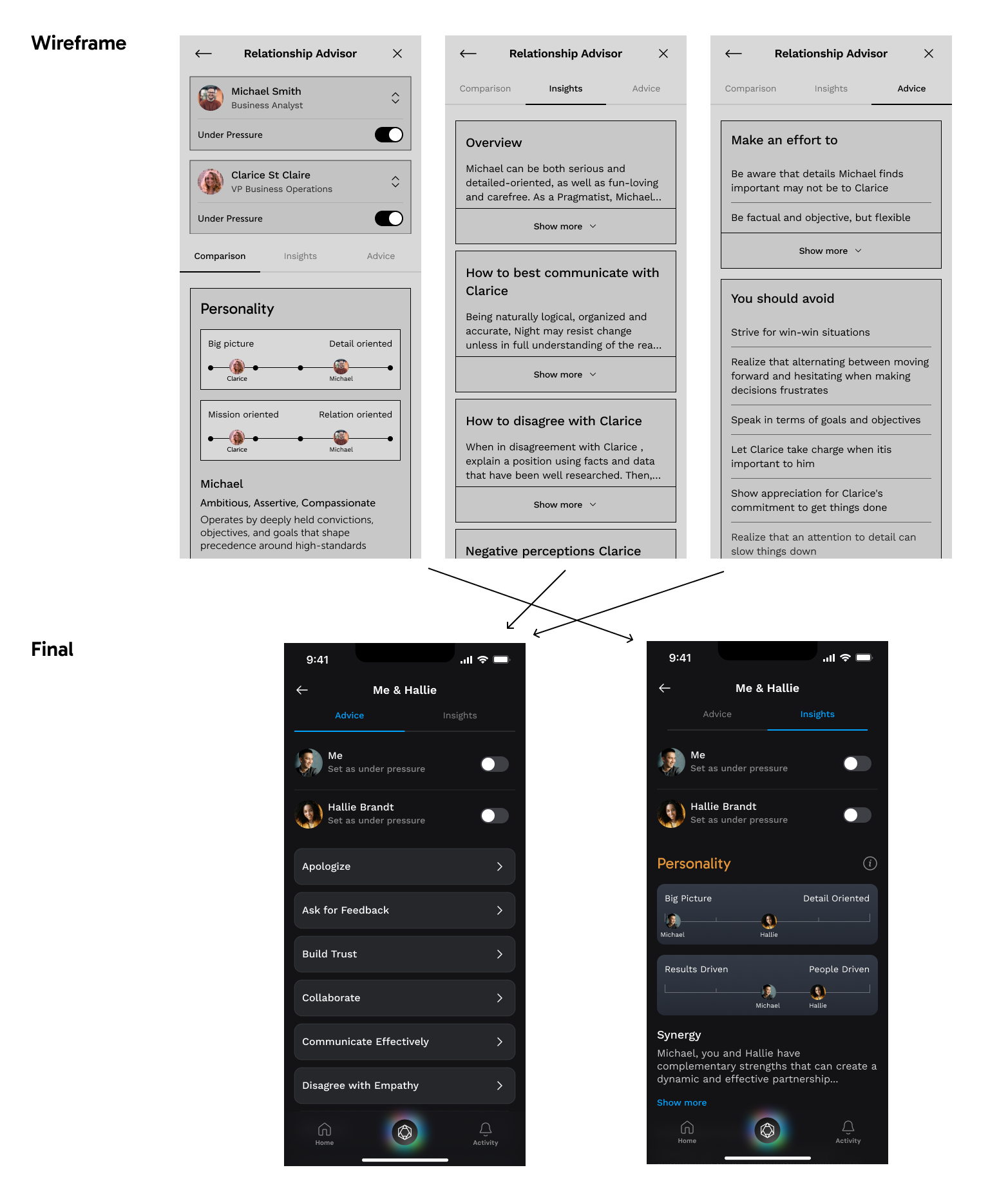
Making a multidimensional relationship easy to navigate.
Advice changes depending on the colleague, workplace situation, and whether someone is operating under pressure. I designed context switching so users could move among those dimensions and immediately see what changed—without losing their place or mistaking one recommendation for another.
High-fidelity prototypes made these transitions tangible during design critiques and engineering reviews. Seeing the experience in motion exposed subtle issues in orientation, pacing, and emphasis early enough to resolve them before implementation.
The outcome.
SureAdvice turned a dense, proprietary psychometric model into an approachable tool for everyday relationship decisions. It gave employees and managers a faster way to prepare for sensitive conversations, understand differences in working style, and adapt their communication with greater empathy and confidence. The module moved from concept to production as part of SurePeople’s new mobile platform, with the shared design system and motion specifications helping engineering preserve the intended clarity and polish.